How to Optimize Content for AI Citations
September 2026 : Bob Sakayama
Getting content cited in AI-generated answers has become an important goal for marketers, publishers, businesses, organizations, and website owners.
People increasingly use AI-powered tools to research topics, compare products and services, solve problems, evaluate options, and make decisions. Instead of reviewing a conventional list of search results, users may receive a synthesized answer assembled from several online sources.
When an AI platform identifies its sources, only a limited number of websites may be cited. Being selected as one of those sources can:
- Increase brand visibility
- Introduce a website to new audiences
- Establish subject-matter authority
- Generate referral traffic
- Influence purchasing or decision-making
- Reinforce the organization’s credibility
- Increase the likelihood of future brand searches
There is no guaranteed method for earning an AI citation. Different AI platforms use different models, search indexes, retrieval systems, ranking methods, and citation policies.
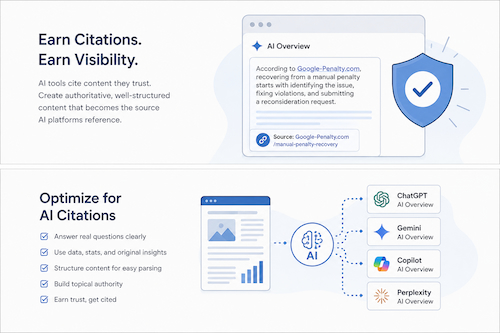
However, content is more likely to be useful to AI systems when it is clearly written, comprehensive, accessible, accurate, well organized, and supported by credible evidence.
The objective is not to manipulate an AI platform into citing a page. The objective is to make the page one of the most useful and dependable sources available for the topic.
How AI Citation Optimization Differs From Traditional SEO
Traditional search engine optimization commonly begins with keyword research.
The website owner identifies the words and phrases people enter into search engines and creates content that satisfies the intent behind those searches.
For example, a website might target the primary query:
“How to choose a project management platform”
Traditional SEO research might identify related terms such as:
- Best project management software
- Project management tools
- Software for managing projects
- Project tracking platforms
- Team collaboration software
- Project management software comparison
The page might then be optimized through:
- A descriptive page title
- A relevant H1 heading
- Supporting headings
- Natural use of related terminology
- Internal links
- External links
- Structured data
- Technical improvements
- Link building
- Content promotion
- User-experience improvements
AI citation optimization includes many of these same practices, but it asks an additional question:
What supporting questions might an AI system investigate before it can produce a complete answer to the user’s query?
Those supporting questions are frequently described as fanout queries or fanout questions.
For traditional SEO, the starting point is often identifying important keywords and search intents. For AI citation optimization, the starting point is discovering the related topics that an AI system needs to address - the fanout questions.
The most effective approach combines traditional SEO with comprehensive question-based content.
What Are Fanout Questions?
Fanout queries or fanout questions are the hidden questions an AI-powered search or research system generates while investigating a broader user request.
Instead of searching only the user’s exact words, the system may divide the request into several information needs. It can retrieve information for each one and combine the findings into a final answer.
For example, consider the broad query:
“How do I choose the right project management platform?”
An AI system might investigate supporting questions such as:
- What features should project management software include?
- How many people will use the platform?
- Which platforms are best for small businesses?
- Which tools are suitable for large organizations?
- What is the difference between task management and project management software?
- How much does project management software cost?
- Which platforms offer free plans?
- What integrations are important?
- Does the platform support remote teams?
- How difficult is the software to implement?
- What security features should businesses evaluate?
- Which platforms provide time tracking?
- What reporting features are available?
- Can the platform support multiple departments?
- How do competing platforms compare?
- What are the limitations of the most popular options?
- What questions should a company ask before purchasing?
The user may never see these individual questions. They operate behind the scenes as part of the AI system’s research process.
A source does not necessarily need to answer every possible supporting question. However, a page or connected group of pages has a better chance of being useful when it addresses the most important questions surrounding the main topic.
Why Fanout Questions Matter
An AI system may not simply cite the page that ranks first for the user’s exact search phrase.
It may instead cite different sources for different parts of the answer.
For example, one source might be selected because it clearly explains essential features. Another might be used for pricing information. A third might provide a comparison table, security guidance, original research, or implementation advice.
This creates opportunities for websites that may not rank first for a broad, competitive query but provide an exceptionally useful answer to a narrower supporting question.
A page is more likely to be useful when it:
- Answers a clearly defined question
- Provides the answer near the beginning of the relevant section
- Explains the subject in sufficient detail
- Includes appropriate qualifications
- Uses descriptive headings
- Provides examples
- Identifies its sources
- Includes current information
- Demonstrates relevant expertise
- Avoids unsupported claims
- Is technically accessible
- Connects readers with related information
The goal is not to repeat the main keyword throughout the page. It is to satisfy the primary information need and the important questions associated with it.
Begin With a Clearly Defined Primary Query
Fanout-query research works best when the primary query is specific enough to represent a genuine user need.
A very broad topic such as:
“Project management”
may produce an unfocused list of questions.
A more useful starting query would be:
“How do I choose the right project management platform for my business?”
Other generic examples include:
- How do I choose the right accounting software?
- What should I consider before replacing my roof?
- How can a small business improve employee retention?
- What is the best way to plan a kitchen renovation?
- How do I compare online learning platforms?
- What should I know before purchasing solar panels?
- How do I select a cybersecurity provider?
- What factors affect the cost of building a website?
- How should a company evaluate a new vendor?
- What should I consider before buying an electric vehicle?
A well-defined query gives the research process direction and produces more useful supporting questions.
How to Discover Important Fanout Questions
AI platforms generally do not provide a complete list of the internal questions they generate. Marketers therefore need to approximate those questions through a combination of AI research, search data, audience research, and subject-matter expertise.
A simple starting prompt is:
“Do whatever research is necessary to identify the 10 most important fanout questions an AI search system may investigate before answering: [INSERT PRIMARY QUERY].”
A more detailed prompt is:
“Research the primary query below and identify the 15 most important fanout questions an AI-powered search system may investigate before generating a complete answer. Group the questions by search intent, explain why each question matters, and recommend the most appropriate type of content for answering it. Primary query: [INSERT PRIMARY QUERY].”
Run the prompt on more than one AI platform. Different systems may suggest different questions because they do not all use the same models, sources, or research methods.
Do not assume every generated question deserves its own section or page. The suggestions should be validated using additional information.
Validate AI-Generated Questions
AI-generated fanout questions are hypotheses. They should be compared with evidence from actual searchers, customers, clients, readers, or users.
Useful sources include:
- Google’s “People also ask” results
- Related searches
- Google Search Console queries
- Bing Webmaster Tools data
- Internal website search data
- Customer-support questions
- Sales-team conversations
- Consultation notes
- Chat logs
- Contact-form submissions
- Product reviews
- Service reviews
- Competitor content
- Industry forums
- Social media discussions
- Video search suggestions
- Webinar questions
- Professional association resources
- Trade publications
- Interviews with subject-matter experts
Questions repeatedly asked by real people should generally receive more attention than questions appearing only in an AI-generated list.
The strongest research process combines AI suggestions with first-party data and human expertise.
Group Questions by Search Intent
Once the supporting questions have been collected, organize them according to what the user is trying to understand or accomplish.
Foundational Questions
These help people understand the basic subject.
Examples:
- What is project management software?
- How does solar energy work?
- What is a home energy audit?
- What does a financial advisor do?
- What is cloud-based accounting?
These questions are often appropriate for overview pages, introductory guides, or glossary sections.
Comparison Questions
These help users distinguish among alternatives.
Examples:
- Project management software versus task management software
- Solar panels versus solar shingles
- Leasing versus buying equipment
- In-house marketing versus hiring an agency
- Custom software versus off-the-shelf software
Comparison questions are often best answered through dedicated comparison articles, tables, or clearly separated page sections.
Eligibility or Suitability Questions
These help users determine whether an option is appropriate for their situation.
Examples:
- Is this platform suitable for a small business?
- Is my roof appropriate for solar panels?
- Does my company need a managed IT provider?
- Is this service suitable for a remote team?
- Should I repair or replace the equipment?
These questions often require nuanced answers rather than universal recommendations.
Feature Questions
These focus on capabilities, components, or specifications.
Examples:
- Which integrations are available?
- Does the platform support time tracking?
- What reporting tools are included?
- Does the product include a warranty?
- Can the system support multiple locations?
Feature questions may belong on product pages, service pages, comparison charts, or technical documentation.
Process Questions
These explain what happens before, during, or after a purchase, service, or decision.
Examples:
- How is the system implemented?
- What happens during the consultation?
- How long does installation take?
- What preparation is required?
- How are existing records transferred?
Process explanations are especially valuable because organizations often have first-hand knowledge that generic publishers do not.
Cost Questions
These address financial considerations.
Examples:
- How much does the service cost?
- What factors affect pricing?
- Are there setup fees?
- Is a subscription required?
- Are there long-term contracts?
- What additional costs should buyers anticipate?
A business does not always need to publish exact prices. It can still explain pricing models, cost factors, typical variables, and questions customers should ask.
Risk and Limitation Questions
These address concerns, drawbacks, or potential problems.
Examples:
- What are the disadvantages?
- What limitations should buyers understand?
- What implementation problems are common?
- What happens if the platform is discontinued?
- What security risks should be considered?
- What mistakes should customers avoid?
Content becomes more trustworthy when it addresses limitations rather than discussing only benefits.
Outcome Questions
These focus on results and expectations.
Examples:
- How long does it take to see results?
- What does successful implementation look like?
- How is performance measured?
- What factors influence the outcome?
- What results should customers realistically expect?
Avoid guaranteeing results that depend on circumstances outside the organization’s control.
Decision Questions
These help users make a final choice.
Examples:
- What questions should I ask a provider?
- How should I compare proposals?
- Which features are essential?
- What should be included in the contract?
- What warning signs should I look for?
- How can I evaluate customer support?
Decision-oriented content can be particularly valuable because it supports users near the end of the research process.
Map Questions to the Right Type of Content
Not every fanout question should become a new page.
After grouping the questions, determine where each answer belongs.
Possible content formats include:
- Main service pages
- Product pages
- Category pages
- Comprehensive guides
- Supporting articles
- Comparison pages
- FAQ sections
- Glossaries
- Case studies
- Research reports
- Technical documentation
- Buying guides
- Checklists
- Location pages
- Calculators
- Videos
- Infographics
- Downloadable resources
A broad question may need a complete guide. A narrow question may require only a short FAQ answer. A complicated comparison may deserve its own page.
The objective is to build a logical information structure rather than publish a large collection of disconnected articles.
Build Topic Clusters
A strong content strategy usually involves a central page supported by more detailed resources.
For the example topic, the central page might be:
How to Choose the Right Project Management Platform
Supporting pages could include:
- Essential project management software features
- Project management software for small businesses
- Project management software for remote teams
- Free versus paid project management platforms
- How to compare project management software pricing
- Common project management implementation mistakes
- Project management software security considerations
- How to migrate from one platform to another
- Questions to ask before selecting a platform
- Project management software comparison checklist
These pages should link to one another where the connection is genuinely useful.
A topic cluster helps users explore the subject while also showing search and retrieval systems that the website covers the topic in depth.
Avoid Creating One Overloaded Page
Comprehensive content does not mean forcing every related question onto one extremely long page.
An overloaded page can become difficult to navigate. Important answers may be buried, repeated, or reduced to a few superficial sentences.
Keep closely related questions together, but separate topics when:
- The question has a distinct search intent
- The answer requires substantial detail
- The audience is different
- The topic deserves its own comparison
- The information changes at a different rate
- The subject requires specialized evidence
- The page would become difficult to use
- The supporting topic has meaningful search demand
The main page should provide enough information to satisfy the primary query while linking to deeper resources when necessary.
Provide Direct Answers
AI systems and human readers both benefit when the answer is easy to find.
Begin each important section with a concise response to the heading. Then provide supporting explanation, examples, evidence, exceptions, and recommendations.
For example:
How Much Does Project Management Software Cost?
Project management software may be offered through a free plan, a monthly per-user subscription, a flat organizational fee, or a custom enterprise contract. The total cost can depend on the number of users, storage limits, reporting features, integrations, security requirements, customer support, and implementation services.
The section could then explain:
- Free-plan limitations
- Per-user pricing
- Annual discounts
- Enterprise pricing
- Setup and training costs
- Migration expenses
- Integration fees
- Add-on features
- Contract requirements
- Total cost of ownership
This structure provides an immediate answer without sacrificing necessary detail.
Use Descriptive Headings
Headings should identify exactly what the section covers.
Vague heading:
Things to Consider
More useful heading:
What Features Should You Compare Before Choosing a Platform?
Vague heading:
Our Process
More useful heading:
What Happens During Software Implementation?
Vague heading:
Costs
More useful heading:
What Factors Affect the Total Cost?
Descriptive headings improve navigation and help retrieval systems identify relevant passages.
Not every heading must be written as a question. A natural combination of explanatory and question-based headings usually produces the best reading experience.
Make Important Passages Self-Contained
An AI system may retrieve a specific paragraph or section rather than evaluate the entire page as a single unit.
Review important passages to determine whether they make sense independently.
A useful passage should:
- Identify the topic
- Provide a direct answer
- Define unfamiliar terminology
- Include necessary qualifications
- Avoid unclear references
- Support factual claims
- Explain important exceptions
- Remain understandable outside the surrounding text
Avoid passages that depend heavily on phrases such as:
- This option
- It
- They
- The above service
- As previously explained
- This approach
Repeating the relevant subject where necessary can make an extracted passage easier to interpret accurately.
Use FAQs Strategically
FAQ sections are useful because they directly pair questions with answers.
They can address important fanout questions that do not require complete standalone pages.
A strong FAQ answer should:
- Answer the question immediately
- Provide enough explanation to be useful
- Include relevant qualifications
- Avoid unsupported claims
- Define specialized terms
- Link to additional information when appropriate
Weak answer:
How Much Does It Cost?
Contact us for pricing.
Stronger answer:
How Much Does Project Management Software Cost?
The cost depends on the pricing model, number of users, features, integrations, storage requirements, support level, and contract terms. Some providers offer limited free plans, while others charge per user each month or provide custom enterprise pricing. When comparing costs, consider implementation, training, migration, and add-on fees in addition to the advertised subscription price.
An FAQ should supplement the main content. It should not be used to hide essential information that deserves a complete section.
Demonstrate Experience and Expertise
Generic summaries are easy to reproduce. Original experience is more difficult to replace.
Organizations should include information derived from real work, research, observation, and expertise.
Depending on the topic, this might include:
- Original research
- Internal data
- Expert commentary
- Case studies
- Project examples
- Customer questions
- Implementation lessons
- Common mistakes
- Decision-making criteria
- Industry-specific considerations
- Local knowledge
- Proprietary methods
- Survey results
- Process documentation
- Original photographs
- Original diagrams
- Performance benchmarks
For example, a software consultant might explain which migration problems occur most frequently. A contractor might explain how site conditions affect project planning. A retailer might explain how materials influence durability. A financial professional might explain the questions clients commonly misunderstand.
Specific, experience-based details give the content a stronger reason to be selected over a generic summary.
Support Claims With Reliable Sources
Content becomes more credible when factual claims can be verified.
Depending on the topic, useful sources may include:
- Government agencies
- Academic research
- Professional associations
- Industry standards
- Regulatory bodies
- Manufacturer documentation
- Technical specifications
- Original datasets
- Court decisions
- Company filings
- Reputable research organizations
- Recognized trade publications
Whenever possible, use the original or primary source rather than a page summarizing another source.
Avoid vague statements such as:
- Studies show
- Experts agree
- Research proves
- It is widely known
- Most customers prefer
Identify the evidence supporting the statement and accurately represent what that evidence establishes.
Explain Important Qualifications
Simple answers can become misleading when necessary qualifications are omitted.
For example:
“Free project management platforms are best for small teams.”
This statement is too broad. A more useful explanation would be:
“A free project management platform may be sufficient for a small team with basic task-tracking needs, but storage, reporting, automation, user permissions, integrations, and customer support may be limited.”
Qualifications improve accuracy and reduce the chance that an extracted passage will overstate the conclusion.
Useful qualifying language includes:
- May
- Can
- Often
- Generally
- In some cases
- Depending on
- Under certain conditions
- For organizations that
- Results vary according to
Qualification should clarify uncertainty without making every answer vague or noncommittal.
Address Drawbacks and Alternatives
Content that discusses only advantages may appear promotional rather than informative.
A comprehensive page should address:
- Potential disadvantages
- Appropriate alternatives
- Situations where the option may not be suitable
- Common implementation problems
- Additional costs
- Practical limitations
- Risks
- Tradeoffs
For example, a software comparison should not merely list features. It should also explain where each option may be weaker, which users may find it unsuitable, and what compromises may be required.
Balanced content is more useful for decision-making and often more credible.
Use Tables and Lists Appropriately
Tables are useful when users need to compare several options across consistent criteria.
A project management platform comparison might include:
- Target user
- Pricing model
- Free plan
- Integrations
- Time tracking
- Reporting
- Automation
- Mobile access
- Security features
- Customer support
- Primary limitation
Lists work well for:
- Features
- Requirements
- Warning signs
- Preparation steps
- Questions to ask
- Common mistakes
- Advantages
- Limitations
- Eligibility factors
However, a page should not consist entirely of lists. Important subjects require explanation and context.
Strengthen Entity Clarity
AI systems need to understand the people, products, companies, services, places, and concepts discussed on the page.
Make entities clear by:
- Using complete names
- Identifying relationships
- Defining abbreviations
- Maintaining consistent terminology
- Explaining the organization’s role
- Providing accurate business information
- Identifying authors and reviewers
- Linking to relevant profile pages
- Using appropriate structured data
- Avoiding ambiguous references
For example, do not alternate among several unexplained names for the same service. Introduce the full name first, define any abbreviation, and use terminology consistently.
Improve Trust Signals
Trust signals help readers evaluate whether the source is credible.
Useful signals may include:
- Named authors
- Author biographies
- Professional qualifications
- Expert reviewers
- Publication dates
- Meaningful update dates
- References
- Editorial policies
- Correction policies
- Accurate contact information
- Complete business information
- Transparent ownership
- Privacy policies
- Terms and conditions
- Clear disclosures
- Original examples
- Real staff profiles
- Customer-support information
The most important signals depend on the subject. A medical page, financial guide, software review, historical article, and local service page will not require exactly the same evidence of credibility.
Make the Content Technically Accessible
Excellent content cannot be cited if retrieval systems cannot access it.
Technical considerations include:
- Correct indexability
- Appropriate robots.txt rules
- Accurate canonical tags
- Valid status codes
- Accessible HTML content
- Mobile usability
- Secure HTTPS pages
- Fast loading
- Stable page rendering
- Descriptive internal links
- XML sitemaps
- Functional navigation
- Limited duplication
- Correct redirects
- Structured data that matches visible content
- Accessible expandable sections
- Minimal intrusive overlays
Avoid placing important information only inside:
- Images
- Videos without transcripts
- Downloadable documents
- Complicated scripts
- Interactive elements that fail to render
- Forms requiring submission
- Tabs that prevent crawling
- Password-protected areas
Important information should generally be available as readable HTML.
Continue Applying Traditional SEO
AI citation optimization does not replace conventional SEO.
Content still benefits from:
- Keyword research
- Search-intent analysis
- Descriptive title tags
- Useful meta descriptions
- Logical headings
- Internal linking
- External authority signals
- Technical SEO
- Link earning
- Brand mentions
- Local SEO
- Content promotion
- Page performance
- Mobile accessibility
- Positive user experience
Pages with strong search visibility may be easier for AI retrieval systems to discover. High-ranking content may also have a better chance of being cited when it answers important fanout questions.
Traditional SEO and AI optimization should therefore be treated as complementary strategies.
Keep Information Current
Content freshness is especially important for subjects that change frequently.
Examples include:
- Prices
- Laws
- Regulations
- Software features
- Product specifications
- Professional guidance
- Statistics
- Industry standards
- Availability
- Company leadership
- Technology
- Market conditions
During a content review:
- Verify facts
- Check statistics
- Update dates
- Test links
- Confirm that products and services still exist
- Review professional guidance
- Remove outdated recommendations
- Add emerging questions
- Update examples
- Correct broken internal links
- Review structured data
- Confirm author and reviewer information
Do not change the publication date merely to make unchanged content appear recent. Update the date when the page has been meaningfully reviewed or revised.
Monitor AI Citations and Visibility
AI visibility can be difficult to measure because platforms do not always provide complete referral data.
Possible indicators include:
- Referral traffic from AI platforms
- Brand mentions in generated answers
- Direct citations
- Increased branded searches
- Growth in long-tail search visibility
- Search Console impressions
- Assisted conversions
- Leads mentioning an AI platform
- Links earned by original research
- Increased visibility for supporting questions
Develop a set of representative prompts and test them periodically.
For each prompt, record:
- Which organizations are mentioned
- Which sources are cited
- What page types are selected
- Which questions are addressed
- Which competitors appear
- Whether the information is accurate
- Whether your brand is misrepresented
- Which content gaps remain
AI responses may differ according to platform, model, user, location, session, and date. One test should not be treated as conclusive. Look for recurring patterns.
Common Mistakes to Avoid
Focusing Only on Keywords
Keywords remain important, but repeating a phrase does not make a page comprehensive or authoritative.
Publishing Thin FAQ Pages
Creating a separate page for every minor question can lead to weak, repetitive content. Consolidate closely related questions when appropriate.
Using AI Questions Without Validation
AI-generated fanout questions should be compared with actual search data, customer questions, and expert knowledge.
Publishing Unreviewed AI Content
AI-generated drafts may contain errors, unsupported claims, repetition, or generic language. Subject-matter review remains essential.
Hiding the Answer
Do not bury useful information beneath several paragraphs of promotional copy.
Ignoring Limitations
Content that discusses only benefits may be less credible and less useful.
Copying Competitors
Competitor research can reveal gaps, but reproducing the same information does not create a distinctive source.
Treating Every Platform the Same
Different AI platforms may retrieve and cite information differently.
Overloading a Single Page
A page can be comprehensive without attempting to cover an entire subject in one document.
Creating Content Unrelated to User Intent
Do not add sections merely because an AI tool suggested them. Every addition should support a genuine audience need.
Expecting Guaranteed Citations
No platform guarantees that a particular page will be cited. Optimization improves the opportunity; it does not control the final output.
A Practical AI Citation Optimization Process
Step 1: Choose the Primary Query
Select a query connected to an important audience need, business service, product, problem, or decision.
Step 2: Clarify the Search Intent
Determine whether the user wants to learn, compare, purchase, solve a problem, evaluate a provider, or make a decision.
Step 3: Generate Potential Fanout Questions
Use several AI platforms to identify supporting questions.
Step 4: Validate the Questions
Compare the suggestions with search data, customer questions, competitor pages, forums, reviews, and expert input.
Step 5: Group Questions by Intent
Organize them into categories such as foundational, comparison, suitability, process, cost, risk, outcome, and decision questions.
Step 6: Map Questions to Existing Content
Determine which questions are already answered and where those answers appear.
Step 7: Identify Gaps
Find questions that are unanswered, partially answered, outdated, difficult to locate, or answered only through promotional language.
Step 8: Select the Right Format
Decide whether each question belongs in an existing section, an FAQ, a supporting article, a comparison page, a guide, a case study, or another format.
Step 9: Improve the Answers
Add clear explanations, evidence, examples, qualifications, expert commentary, tables, lists, and internal links.
Step 10: Review Passage Clarity
Make sure important sections can be understood when retrieved independently.
Step 11: Check Technical Accessibility
Confirm that the page can be crawled, indexed, rendered, and interpreted.
Step 12: Publish and Promote
Promote the resource through relevant channels, outreach, newsletters, partnerships, professional communities, digital PR, and social media.
Step 13: Monitor Performance
Track search visibility, referrals, citations, brand mentions, engagement, leads, and emerging questions.
Step 14: Update the Content
Review the page regularly and revise it when facts, services, products, standards, or user needs change.
AI Citation Content Audit Checklist
Use the following questions when reviewing a page:
- What primary question does the page answer?
- Is the primary answer clear?
- Does the answer appear early enough?
- What supporting questions might an AI system investigate?
- Which supporting questions are fully answered?
- Which questions are only partially answered?
- Which questions are missing?
- Are the headings descriptive?
- Are important passages understandable independently?
- Are specialized terms defined?
- Are factual claims supported?
- Are important limitations explained?
- Are alternatives discussed?
- Does the content demonstrate real expertise?
- Does it include original information?
- Are related pages connected through internal links?
- Is the information current?
- Is the page technically accessible?
- Is the content overly promotional?
- Does the page satisfy the main search intent?
- Are tables or lists needed?
- Are authors and reviewers identified where appropriate?
- Is structured data accurate?
- Does the page provide information competitors do not?
- Is there a clear process for reviewing and updating it?
Improved Prompt for Discovering Fanout Questions
Use this prompt to research supporting questions:
“Research the primary query below and identify the 15 most important supporting questions an AI-powered search system may investigate before producing a complete answer. Group the questions by search intent. For each question, explain why it matters, what information a strong answer should include, and whether it should be addressed on the main page, in an FAQ, or in a separate supporting resource. Do not include questions that are only loosely related to the user’s likely intent. Primary query: [INSERT PRIMARY QUERY].”
Prompt for Auditing Existing Content
Use this prompt to evaluate an existing page:
“Review the content below in relation to the primary query and its likely supporting questions. Identify which questions are fully answered, partially answered, or unanswered. Recommend specific additions, removals, headings, examples, evidence, tables, FAQs, and internal links that would make the page more useful to readers and AI-powered search systems. Preserve the main search intent and do not recommend unrelated content. Primary query: [INSERT PRIMARY QUERY]. Content: [INSERT CONTENT OR URL].”
Prompt for Comparing Multiple Pages
Use this prompt to compare a page with competing resources:
“Compare the following pages based on how well they answer the primary query and its most important supporting questions. Identify the strengths, weaknesses, missing information, unique insights, source quality, structure, and level of detail of each page. Then recommend how the target page can become more complete, credible, clear, and useful without copying the competitors. Primary query: [INSERT PRIMARY QUERY]. Target page: [INSERT URL]. Comparison pages: [INSERT URLS].”
The Key Takeaway
Traditional SEO focuses on helping content rank for keywords and satisfy the searcher’s primary intent.
AI citation optimization also focuses on answering the supporting questions an AI system may investigate while preparing its response.
The strongest strategy combines both approaches.
A page should be searchable, technically accessible, credible, current, and optimized for its primary topic. It should also provide clear answers to the related questions that naturally arise around that topic.
The more relevant questions the content answers well, the more opportunities it may have to be retrieved, summarized, referenced, and cited in AI-generated results.
The goal is not simply to publish more content.
The goal is to become one of the clearest, most complete, most dependable, and most useful sources available for the subject.