Is Google Enabling Fraud & Harm via their SERPS?
When Google Ranks Eating Disorder Hope Above the Brand a User Is Searching For, Consumers Are Being Mislead
Google has repeatedly stated that its mission is to organize the world's information and provide users with the most relevant results for their searches. When someone searches for the name of a specific eating disorder treatment provider, most people reasonably expect the provider's official website to appear first. These are known as navigational searches—searches in which the user has already decided which organization they want to visit.
Yet for many branded eating disorder treatment searches, that is not what happens.
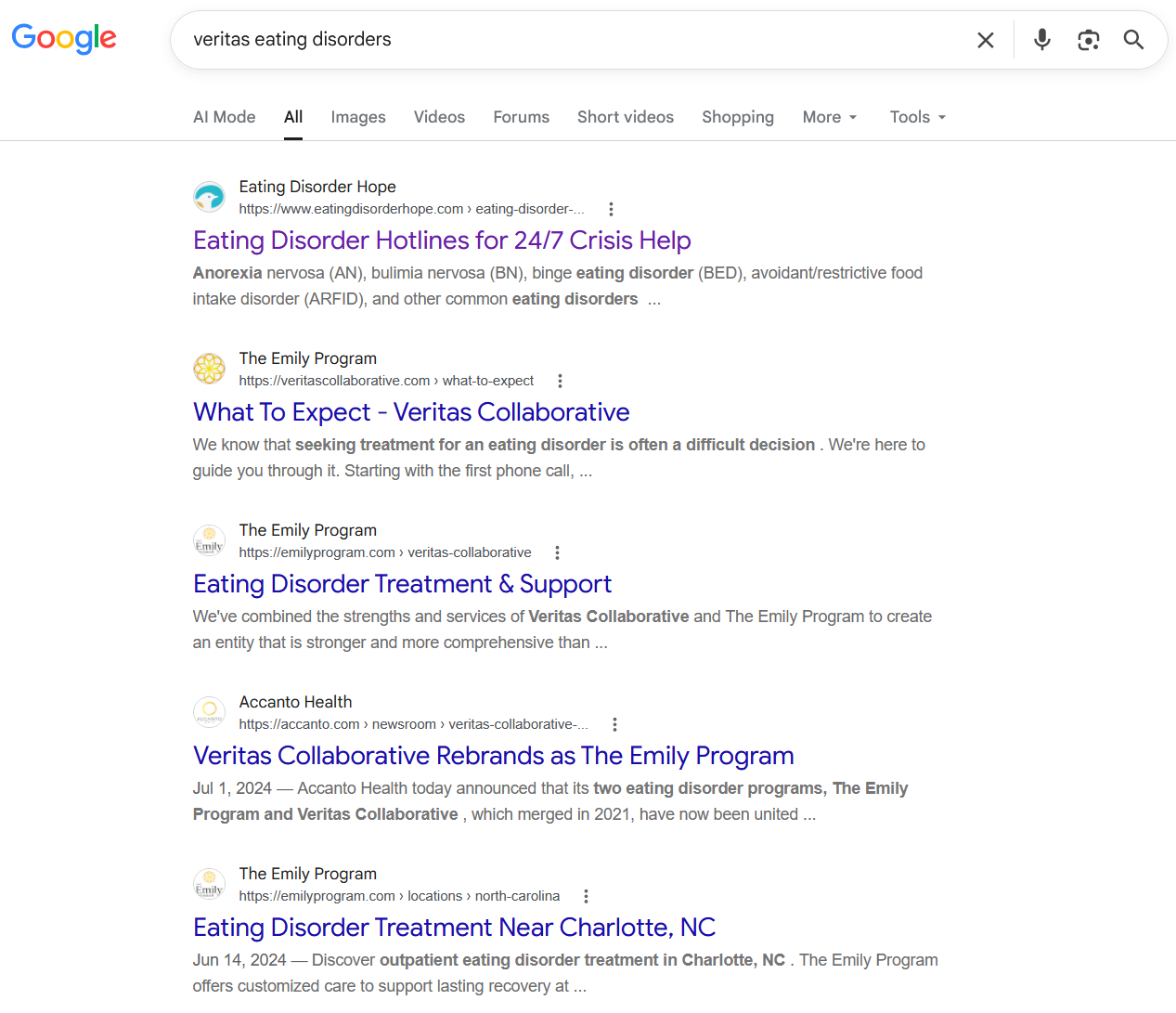
Instead, Google frequently places Eating Disorder Hope (EDHope) above the official website of the treatment provider the user specifically searched for. A parent searching for "Veritas eating disorders," for example, may first encounter EDHope rather than Veritas Collaborative's own website. The attached search result illustrates this pattern: Google displays EDHope as the first organic result, while the official Veritas Collaborative page appears below it.
This ranking might appear harmless if EDHope were simply an independent educational publisher providing neutral information. However, ownership of EDHope changed significantly in 2026. According to public announcements and information described in the accompanying materials, EDHope is now operated by Hopeful Media, LLC, a wholly owned subsidiary of Within Health Group, Inc. Within Health is itself a for-profit virtual eating disorder treatment provider.
That corporate relationship fundamentally changes how these search results should be viewed.
When Google places an intermediary website owned by one treatment company ahead of the official website of a competing provider, it creates the possibility that consumers—many of whom are frightened parents urgently seeking care for a loved one—may be diverted before ever reaching the organization they intended to contact.
This article does not argue that Google intentionally favors any particular company. Nor does it suggest that every visitor to EDHope receives inaccurate information. Rather, it examines whether Google's ranking system may unintentionally facilitate a commercial structure that can redirect highly vulnerable consumers away from the provider they deliberately searched for and toward a website owned by one of its competitors.
In healthcare, where treatment decisions can have life-altering consequences, that distinction matters.
If search engines consistently elevate intermediary sites above the very healthcare providers users are attempting to reach, the result is more than an SEO curiosity. It becomes a consumer protection issue deserving careful examination.
The question is therefore not whether EDHope is entitled to rank in Google. It clearly is. The more important question is whether Google's algorithms should allow a commercially affiliated intermediary to consistently outrank the official website of the very treatment provider a user intentionally searched for, particularly when the intermediary has its own financial interests in patient acquisition.
The answer affects far more than search rankings. It affects who receives the first opportunity to influence some of the most important healthcare decisions a family may ever make.
When Google Stops Being a Navigator: How Branded Search Results Can Harm Consumers and Legitimate Healthcare Providers
For more than two decades, Google has promoted its mission of organizing the world's information and helping users find what they are looking for. Consumers have come to trust that when they type the name of a specific business into Google, the search engine will help them reach that business.
Increasingly, however, some healthcare providers argue that this expectation is no longer being met.
Instead of directing users to the organization they intentionally searched for, Google's search results can prominently feature third-party publishers, directories, or lead-generation businesses that compete for the same patients. The result is not merely an SEO inconvenience—it can affect healthcare decisions, divert potential patients, and impose significant costs on organizations that spent years building trusted brands.
The broader question is no longer whether these ranking outcomes occur. They do. The more important question is whether Google's current approach adequately protects consumers and fairly reflects user intent.
Branded Searches Are Different
Not all searches are created equal.
When someone searches for "menopause symptoms" or "eating disorder treatment," Google must determine which sources are most relevant.
A branded search is fundamentally different.
When someone searches for:
ViaMar Health
Mayo Clinic
Cleveland Clinic
Johns Hopkins
Nore Health
the user is generally not asking Google to recommend alternatives.
They are asking Google to help them reach a specific organization.
Historically, search engines understood this distinction. Branded queries were treated primarily as navigational requests.
Many affected businesses argue that Google's current systems no longer consistently make that distinction.
Why This Matters in Healthcare
Healthcare is unlike shopping for shoes or electronics.
Patients searching for a particular provider often do so because:
they were referred by a physician;
they researched treatment options extensively;
they previously received care there;
they have already decided where they want treatment.
If Google instead elevates an intermediary that captures the user's attention before they reach the intended provider, the search experience no longer simply reflects relevance—it changes the patient's path.
Whether those outcomes result from ranking algorithms, advertising incentives, or other design choices, the practical effect can be the same: the patient may never reach the provider they intended to contact.
The Economics of Patient Diversion
Building a healthcare brand requires years of investment.
Providers spend substantial resources on:
physician recruitment,
clinical outcomes,
patient education,
community outreach,
reputation management,
content creation,
local marketing.
Those investments are made with the expectation that consumers searching for the organization's name will be able to find it easily.
When third-party businesses receive substantial traffic from those branded searches, providers may lose opportunities despite having generated the underlying consumer awareness.
Critics argue that this effectively shifts the value of brand-building from the organization that earned the consumer's trust to another entity that did not create that relationship.
Publicly Reported Ownership Raises Questions
Public records indicate that Hopeful Media, LLC is associated with the Eating Disorder Hope website and is owned by Within Health Group, Inc.
That ownership structure is itself a matter of public record.
The policy questions arise from what follows.
When an educational website also exists within the corporate structure of an organization involved in patient acquisition or treatment services, some observers argue that readers deserve clear transparency regarding potential commercial interests.
This does not necessarily mean that the site's educational content is inaccurate or misleading.
It does, however, raise reasonable questions about:
editorial independence,
disclosure,
referral practices,
conflicts of interest,
consumer expectations.
Those questions deserve careful examination because healthcare information carries consequences that extend far beyond ordinary online publishing.
Google's Role
Google did not create these business models.
Google does, however, determine how prominently they appear.
Every ranking decision reflects choices made by Google's algorithms.
When those systems repeatedly place intermediaries ahead of the organization a user explicitly searched for, critics argue that Google's role extends beyond passive indexing.
Whether intentional or not, Google's systems become part of the mechanism through which traffic is redistributed.
That distinction matters.
Google may not be responsible for creating every business model that benefits from search visibility.
But Google is responsible for how its search systems interpret user intent.
When User Intent Is Ignored
Imagine asking a taxi driver to take you to a specific hospital.
Instead, the driver first stops at a medical referral office that offers to suggest other hospitals.
Few people would consider that acceptable.
Yet some businesses argue that this is effectively what happens online.
A consumer searches for a known provider.
Google presents competing intermediaries.
The intermediary attempts to engage the user before they reach the intended destination.
Even if the original provider remains somewhere on the page, the consumer's intended journey has already been interrupted.
Why Traditional SEO Often Cannot Solve the Problem
Businesses are frequently told to improve:
content,
authority,
backlinks,
technical SEO,
user experience.
Those recommendations may help for informational searches.
They do little when the issue involves branded navigational intent.
No amount of additional content changes the fact that a consumer already searched for a specific organization.
Affected providers argue that the problem lies not with their websites but with Google's interpretation of navigational searches.
If that interpretation is incorrect, businesses have little practical ability to fix it themselves.
A Growing Policy Question
This debate is larger than any single company.
It touches broader questions about:
search neutrality,
market power,
consumer protection,
competition,
transparency.
As Google increasingly mediates access to healthcare information, policymakers may ask whether existing safeguards adequately protect users searching for specific providers.
Those questions deserve careful consideration because search engines increasingly function as gateways rather than mere indexes.
Are Legal and Regulatory Responses Worth Exploring?
Reasonable people can disagree about whether Google's current practices violate any particular law.
However, the concerns raised by affected businesses suggest several areas that may warrant examination by courts, regulators, or legislators, depending on the facts of individual cases. These include:
+ consumer protection principles where search presentation may create confusion about a user's intended destination;
+ competition issues related to how dominant search platforms handle navigational queries;
+ unfair competition theories where a business believes it has suffered measurable harm from diverted branded traffic;
+ transparency obligations regarding commercial relationships or conflicts of interest when healthcare information and patient acquisition intersect.
Whether any specific legal claim would succeed depends on the evidence and the applicable law. Those questions are ultimately for courts and regulators to decide, not for search engines or the businesses affected by their rankings.
The Conversation Should Focus on Consumers
The central issue is not whether one website outranks another.
It is whether consumers searching for a specific healthcare provider are being helped or hindered.
If users repeatedly struggle to reach the organization they intentionally searched for, confidence in search results may erode.
Healthcare decisions depend on trust.
Search engines play an increasingly influential role in those decisions.
With that influence comes a corresponding responsibility to ensure that navigational searches respect user intent and that search presentation does not unnecessarily create confusion.
Whether improvements come through voluntary changes by Google, clearer disclosure practices within the healthcare publishing industry, or future regulatory action, the goal should remain the same: helping consumers reach the information and providers they deliberately chose to find.
Also see: Google Is Harming Us