SEO Myths : Explained & Corrected
Why SEO Myths Spread
SEO myths thrive because search algorithms are opaque, experiments are hard to control, and marketers often mistake correlation for causation. Changes in rankings can coincide with a specific tweak (like changing title tags or adding links), and people understandably credit the last change they made instead of the broader context.
These myths are reinforced by:
- Outdated advice that keeps circulating long after Google’s algorithms have changed.
- Oversimplified “growth hacks” that ignore how complex modern search actually is.
- AI tools and SEO software trained on old content, amplifying misconceptions instead of debunking them.
Understanding what’s not true is just as important as knowing best practices, because myths can lead to wasted budget, poor user experience, and even real search visibility issues.
Read Bob's related article "Google Penalty Myths"
Myth 1: Buying Google Ads Helps Organic Rankings
Many businesses assume that spending money on Google Ads will “unlock” better organic rankings as a reward for being a good paying customer. There is no evidence that Google’s organic search algorithm uses ad spend as a ranking factor, and Google has repeatedly stated that the systems are separated.
What can happen is:
- Running ads increases brand visibility, which can drive more branded searches, direct visits, and links, indirectly helping SEO over time.
- Ads provide data (e.g., keyword performance, conversion insights) that you can use to refine your SEO targeting and content strategy.
So while paid and organic strategies can complement each other, you cannot buy your way into higher organic rankings simply by increasing your ad budget. Treat paid search and organic search as different, coordinated channels rather than assuming one directly boosts the other.
Myth 2: Too Many Nofollow Links Will Get You Penalized
Some SEOs worry that acquiring “too many” nofollow links will look suspicious and trigger a penalty. In reality, nofollow links are signals to search engines that the site does not want to pass ranking credit; they do not count as manipulative link schemes by default.
Key points:
- Nofollow links are common in user-generated content, forums, comments, and many editorial contexts.
- A natural backlink profile includes a mix of followed and nofollowed links from a variety of domains and pages.
- The risk lies in manipulative link schemes, not in the presence of nofollow attributes themselves.
Instead of worrying about “too many” nofollows, focus on earning genuinely useful links from relevant sites, regardless of whether they pass full PageRank signals.
Myth 3: Splitting an Article Across Multiple Pages Improves SEO
The idea behind this myth is that paginating an article (“Part 1, Part 2, Part 3”) will create more indexed pages and more opportunities to rank. In practice, splitting content can weaken the user experience and dilute engagement.
Pagination can make sense for very long guides, product listings, or archives, but splitting a normal article purely for SEO is usually unnecessary.
- It can frustrate users who want to read the full article in one place.
- It can make content feel thin or artificially inflated.
- It may divide internal links and engagement signals across multiple URLs.
If the content belongs together, keep it together. Use clear headings, jump links, and good formatting instead of unnecessary page breaks.
Myth 4: More Pages Always Means More Traffic
Many websites assume that publishing more pages automatically creates more chances to rank. But search engines do not reward volume by itself. They reward usefulness, relevance, authority, and quality.
Large numbers of low-quality pages can create problems:
- Thin or repetitive content can weaken the overall perception of a site.
- Index bloat can make it harder for search engines to prioritize your best pages.
- Users may lose trust if they encounter shallow pages that do not answer their questions.
A smaller site with strong, focused, helpful pages can often outperform a larger site filled with weak content.
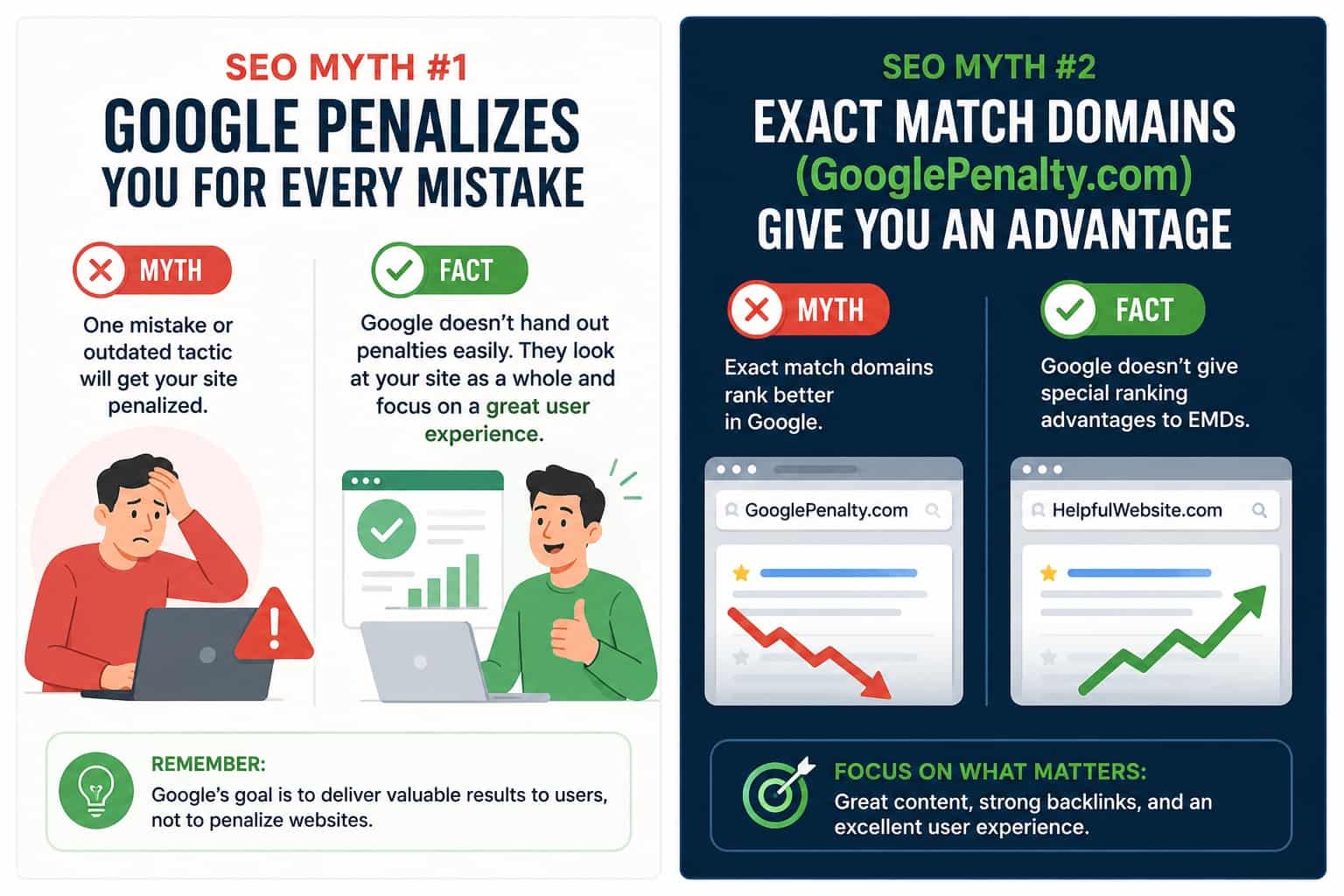
Myth 5: Exact-Match Domains Guarantee Rankings
Exact-match domains once carried more SEO weight than they do today. A domain like “bestplumbercity.com” may help users understand the topic, but it does not guarantee rankings.
Search engines look at much more than the domain name:
- Content quality
- Backlink profile
- Technical performance
- Brand signals
- User satisfaction
- Topical authority
An exact-match domain with thin content and poor trust signals can easily lose to a branded domain with better information, better reviews, stronger links, and a better user experience.
Myth 6: Keyword Density Still Matters Like It Used To
Older SEO advice often focused on repeating a keyword a certain percentage of the time. That approach is outdated. Modern search engines are much better at understanding topics, synonyms, context, and intent.
Keyword usage still matters, but not as a rigid density formula. A good page should naturally include:
- The main topic
- Related phrases
- Clear headings
- Helpful explanations
- Language that matches how users search and think
Forcing keywords unnaturally can make content harder to read and may reduce trust. Write clearly for people first, while making sure the page’s subject is obvious.
Myth 7: Meta Keywords Help Rankings
The meta keywords tag is one of the oldest SEO myths. Major search engines do not use it as a meaningful ranking factor. Adding a long list of keywords into a meta keywords field does not help your page rank.
Instead, focus on elements that matter:
- Helpful title tags
- Clear meta descriptions for click-through appeal
- Well-structured headings
- Useful body content
- Descriptive internal links
Meta keywords are generally unnecessary and can safely be ignored for modern SEO.
Myth 8: Duplicate Content Always Causes a Penalty
Duplicate content is often misunderstood. Having similar or duplicated text does not automatically mean a site will be penalized. Search engines regularly encounter duplicate content across product pages, syndicated articles, printer-friendly pages, and technical URL variations.
The real issue is usually selection and consolidation, not punishment. Search engines may choose one version to show and ignore others.
Problems can arise when duplication is excessive, manipulative, or confusing. To reduce issues:
- Use canonical tags when appropriate.
- Avoid creating multiple near-identical pages for the same intent.
- Consolidate weak overlapping pages.
- Make sure each important page has a clear purpose.
Duplicate content is usually a quality and indexing concern, not an automatic penalty.
Myth 9: Longer Content Always Ranks Better
Long-form content often performs well because it can cover a topic deeply, attract links, and answer many related questions. But length itself is not the ranking factor. A long article that rambles, repeats itself, or buries the answer can perform poorly.
The right length depends on intent:
- A simple definition may need only a short answer.
- A complex buying guide may need thousands of words.
- A local service page may need enough detail to build trust, not an encyclopedia.
Content should be as long as necessary to satisfy the user’s need, and no longer than useful.
Myth 10: You Only Need to Build Links
Links remain important in many competitive search results, but SEO is not only link building. A site with links but poor content, weak technical health, confusing navigation, or bad user experience may still struggle.
Strong SEO usually requires a combination of:
- Useful content
- Technical accessibility
- Fast page performance
- Clear site structure
- Relevant internal linking
- Trustworthy external mentions
Links can amplify a good site, but they cannot always rescue a weak one.
Myth 11: SEO Is a One-Time Project
SEO is sometimes treated as a checklist: optimize title tags, fix a few technical issues, publish content, and move on. But search is dynamic. Competitors improve, algorithms evolve, user behavior changes, and content becomes outdated.
Ongoing SEO includes:
- Updating old content
- Monitoring technical issues
- Improving internal links
- Tracking performance trends
- Refreshing keyword and intent research
- Responding to new opportunities
A one-time cleanup can help, but long-term visibility usually requires ongoing maintenance and improvement.
Myth 12: Social Media Shares Directly Improve Rankings
Social media activity can help content get discovered, but shares and likes are not the same as direct organic ranking signals. A viral post does not automatically push a page higher in Google’s results.
However, social media can indirectly support SEO by:
- Increasing visibility
- Driving referral traffic
- Helping content reach journalists, bloggers, and potential linkers
- Building brand awareness
Social media is valuable, but it should be understood as a discovery and promotion channel rather than a direct ranking lever.
Myth 13: More Backlinks Are Always Better
Counting links without considering quality is a major SEO mistake. A few strong, relevant links can be more valuable than hundreds of weak or irrelevant ones.
Bad link building can create risk when it involves:
- Paid link schemes
- Private blog networks
- Spammy directories
- Irrelevant mass outreach
- Automated link creation
The goal is not simply more links. The goal is more trustworthy, relevant, editorially meaningful links that make sense for your site and audience.
Myth 14: Technical SEO Alone Can Fix Everything
Technical SEO is important. Search engines need to crawl, render, and understand your pages. But technical fixes alone cannot make weak content valuable.
Technical SEO can help with:
- Crawlability
- Indexation
- Site speed
- Structured data
- Mobile usability
- Canonicalization
But once a page is accessible and technically sound, it still needs to satisfy search intent. Technical SEO creates the foundation; content and authority help determine how far the page can go.
Myth 15: AI Content Is Automatically Bad for SEO
AI-generated content is not automatically bad, and human-written content is not automatically good. Search engines care about whether the content is helpful, accurate, original, and trustworthy.
AI can be useful for:
- Outlining topics
- Drafting rough sections
- Summarizing source material
- Generating ideas
- Improving workflow efficiency
But AI content can become a problem when it is inaccurate, generic, mass-produced, unedited, or created only to manipulate search rankings. Human review, expertise, fact-checking, and originality remain essential.
Myth 16: Ranking First Is the Only Goal
Ranking first can be valuable, but it is not the only meaningful SEO goal. Sometimes a lower-ranking page with a stronger title, better snippet, or more relevant intent match can drive better business results.
SEO success can include:
- More qualified traffic
- Higher conversion rates
- Better visibility across multiple queries
- Improved brand trust
- More leads, sales, or inquiries
A ranking is only useful if it attracts the right audience and supports the broader business objective.
Myth 17: SEO Results Should Happen Immediately
Some SEO changes can produce quick improvements, especially technical fixes or updates to already-ranking pages. But many SEO efforts take time. Search engines need to crawl, process, evaluate, and compare pages against competitors.
Timelines vary depending on:
- Site history
- Competition
- Content quality
- Link profile
- Technical health
- Frequency of crawling
SEO is not instant. It is a long-term investment that compounds when the right work is done consistently.
Myth 18: You Should Optimize Every Page for One Exact Keyword
Older SEO strategies often assigned one exact keyword to one page. Today, a strong page can rank for many related queries if it thoroughly satisfies a topic and intent.
Instead of obsessing over one exact phrase, consider:
- The main topic
- User intent
- Related questions
- Synonyms and natural language
- The stage of the customer journey
This does not mean keywords are irrelevant. It means keyword strategy should support topical clarity rather than forcing unnatural repetition.
Myth 19: Competitor Rankings Tell You Everything
Competitor analysis is useful, but copying competitors blindly can lead you in the wrong direction. A competitor may rank because of authority, age, links, brand recognition, or factors you cannot easily see from the page alone.
Use competitor research to understand:
- Common content formats
- Search intent
- Topical gaps
- Useful page structures
- Potential opportunities
But do not assume that copying headings, word count, or keyword usage will reproduce their results. Your goal should be being the best answer for your audience, not just occupying a slot on the results page.
Myth 20: You Must Chase Every Algorithm Update
Finally, many teams panic with each algorithm update, scrambling to implement every new rumor or tweak. While staying informed is important, constantly reacting to speculation is not sustainable.
A healthier approach:
- Focus on durable principles: relevance, quality, topical authority, technical health, and trust signals.
- Monitor your data during updates, identify real trends, and adjust thoughtfully instead of chasing every blog headline.
SEO is a long-term practice; short-term volatility is normal, but solid fundamentals tend to win over time.
By grounding your strategy in evidence-based best practices and user-centric thinking, you can avoid the trap of SEO myths and focus on the actions that genuinely move the needle for visibility, traffic, and business results.