Unresolvable Google Penalty : Harm Without Recourse
Many healthcare providers now depend on Google not just for marketing, but for basic patient access—people type a clinic’s name or phone number into search the way they once dialed directly or walked through the front door. In that environment, when Google quietly reroutes brand name and phone number queries away from a known clinic and toward unaffiliated third parties, the impact stops being a technical SEO issue and becomes a risk to patient safety and trust.
Google’s treatment of ViaMar Health’s brand name and phone number searches shows how search misclassification can inflict penalty like harm on a healthcare provider—diverting patients away from a known clinic toward a third party hotline directory, without any formal notice or practical recourse. This article explains the problem so any reader can understand how it operates, why it is dangerous in a YMYL health context, and how it resembles a Google penalty applied in everything but name.
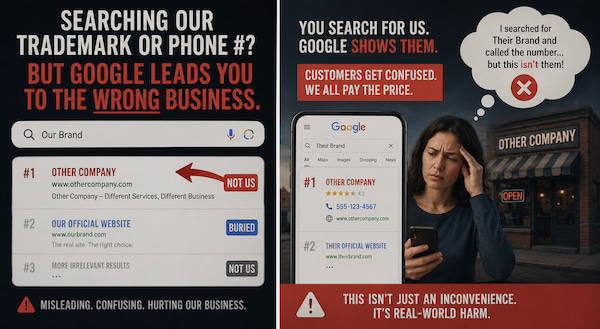
This is NOT as normal ranking issue, it's a Google algorithm bug that's also impacting many other trademark & phone number searches. Let us know if you're seeing a similar problem with your trademark searches - join our class action - hit the contact link at the top of this page, or email bob @ growler.com with "Google penalty" as the subject.
When a Trademark Query No Longer Leads to the Trademark Owner
ViaMar Health is an eating disorder treatment provider operating under its own trademark and serving patients in Florida and beyond. For years, searches for the exact phrase “ViaMar Health” behaved like navigational queries: Google reliably showed the official site, viamarhealth.com, at the top of the organic results, matching the common expectation that typing a business name or phone number into Google is equivalent to direct navigation.
Recently, this behavior changed. On an exact match query for “ViaMar Health,” Google often elevates a third party “Eating Disorder Hotlines” directory from EatingDisorderHope.com above the official site, visually dominating the top of the page with a generic crisis resource. The same pattern appears on searches for ViaMar Health’s main phone number, 561 934 4380: rather than treating this as a confirmation or contact query for the clinic, Google again prioritizes the hotline directory, pushing the clinic’s website and Google Business Profile below it.
In practical terms, this means that people who explicitly type the clinic’s trademark or phone number into Google are being steered first to an unaffiliated organization whose content and call routing the clinic does not control. For individuals already aware of ViaMar Health—patients, families, referrers—Google has replaced direct navigation to a known provider with a generic landing page that may delay or derail an attempt to reach that provider.
Penalty Like Harm Without a Declared Penalty
Google’s own materials distinguish two main types of penalties: manual actions, where human reviewers flag violations and issue notifications in Search Console, and algorithmic demotions, where rankings drop automatically as quality or spam signals are evaluated. In both scenarios, the impact is clear—loss of traffic and visibility—and Google encourages site owners to diagnose problems, remediate issues, and, for manual actions, submit reconsideration requests through documented channels.
The ViaMar Health case produces similar harms: significant reduction in navigational traffic, diminished click through on core brand queries, and confusion among users who reasonably expect to see the official site when they search the clinic’s name or phone number. Yet there is no manual action notice in Search Console, no suggestion of guideline violations, and no obvious index coverage or spam problem to resolve. What has changed is Google’s interpretation of intent: the systems appear to treat “ViaMar Health” and 561 934 4380 as signals that the searcher wants generic eating disorder help, rather than contact with the clinic itself.
Because there is no declared violation, there is also no clearly documented path to recovery. Standard penalty recovery advice—clean up links, improve content quality, submit a reconsideration request—does not apply when Google’s algorithms have simply re assigned brand and phone signals to a different entity. The result is penalty like damage, delivered through misclassification instead of enforcement, and largely invisible in the usual webmaster diagnostics.
Why This Misclassification Is Especially Dangerous in YMYL Healthcare
The stakes are higher because ViaMar Health operates squarely within Google’s “Your Money or Your Life” (YMYL) category, where health related content is expected to meet elevated standards of accuracy, safety, and trust. Eating disorder treatment, crisis intervention, and mental health services fall directly under this umbrella, and misdirection or confusion in this context can carry immediate real world consequences.
In that context, overriding clear navigational intent—substituting a generic hotline directory for an official provider’s site on exact match trademark and phone number queries—creates several risks:
- Individuals under stress who intend to contact a known clinic may be routed into a generic hotline flow that lacks their history, treatment plan, and existing care relationships.
- Family members or clinicians seeking a specific facility may encounter third party branding and phone options that do not clearly represent the provider they meant to reach.
- Responsibility for triage and follow up shifts from licensed providers with a direct duty of care to a directory whose vetting criteria, data accuracy, and call routing are not transparent to the affected clinic.
YMYL guidance emphasizes minimizing potential harm to users, yet this behavior prioritizes a broad, unaffiliated resource over the very provider the user has named explicitly, at the exact moment when direct access may matter most. That makes the misclassification more than a ranking quirk; it is a structural risk to patient safety and continuity of care.
How Similar “Brand Hijacking” Has Appeared in Other Sectors
Although ViaMar Health’s case is unusually high stakes, comparable patterns of “brand hijacking” in search results have been observed across industries. Local SEO practitioners and business owners have reported situations where a company’s website is indexed and visible in other search engines but fails to appear for its own brand name in Google, even as other sites do.
Common themes in these reports include:
- Directory or aggregator pages ranking on exact brand terms and displaying alternative phone numbers, effectively intercepting calls intended for the business.
- Third party review sites or competitors outranking official brands on navigational style queries, leading users to assume that the top result is the company they sought.
- Healthcare and therapy websites that lose visibility after YMYL related updates, as Google’s systems favor generalized informational resources over individual providers.
In each scenario, Google has misinterpreted brand or entity signals, treating them as generic topical queries rather than intent to reach a specific organization. The ViaMar Health case fits this broader pattern, but the combination of crisis context, phone number misrouting, and the vulnerability of eating disorder patients amplifies its impact.
Why Standard “Best Practices” Cannot Fully Solve the Problem
Industry guidance on avoiding or recovering from Google penalties typically focuses on content quality, E E A T (Experience, Expertise, Authoritativeness, Trustworthiness), structured data, technical health, and backlink integrity. Healthcare organizations are urged to demonstrate clinical expertise through credentialed authors, rigorous sourcing, clear review processes, and high quality YMYL content.
Those measures remain important, but in the ViaMar Health situation they do not address the root cause: Google’s systems have begun treating the clinic’s trademark and phone number as generic crisis help signals pointing to another entity’s page. No amount of content improvement can directly prevent that kind of entity misclassification, because it arises from how Google interprets brand signals and query intent rather than from deficiencies on the clinic’s site.
Moreover, standard penalty workflows depend on explicit feedback: Search Console notifications, manual action descriptions, or observable drops tied to specific algorithm updates. Here, the re routing of navigational queries occurs silently. The clinic has already attempted to seek help through Google Search Console forms, Google Business Profile support, and the removals@google.com channel; yet without a defined violation, there is no clear pathway for corrective action. This mismatch between harm and remedy is part of what makes the situation akin to a penalty without due process.
Real World Impact on Brand, Patients, and Trust
When Google points exact match trademark and phone number queries to an unaffiliated resource, the resulting harm extends beyond SEO metrics:
- Brand dilution and misrepresentation: Another organization’s page becomes the primary gateway for ViaMar Health’s brand queries, blending the clinic’s identity into third party messaging and phone routing.
- Patient confusion and delayed care: People who thought they were taking the safest, most straightforward path—typing the clinic’s name or number into Google to confirm they were in the right place—may end up in a generic hotline system instead.
- Loss of control over crisis communications: The clinic no longer controls the first message or contact options offered to a person seeking its help; that responsibility effectively moves to an entity whose priorities and protocols may differ.
In an offline analogy, this would be similar to placing a different company’s sign above a clinic entrance or rerouting calls from the clinic’s phone number to an unrelated help line—actions that would likely raise immediate legal and regulatory concerns. Online, the same practical outcome arises from automatic ranking and entity decisions, with few mechanisms for affected providers to contest or correct them.
Limited Remedies and the Need for Policy Level Change
For any organization facing similar misclassification, a handful of steps may help assert brand identity and document harm, even though they cannot guarantee a fix:
- Strengthen structured data and entity signals so that the website and Business Profile consistently declare the exact brand name, phone number, and organization details.
- Collect timestamped screenshots and logs showing third party pages outranking official sites on exact match brand and phone queries, along with notes about user journey risks.
- Frame appeals to Google not only as SEO complaints, but as YMYL and safety issues, citing Google’s own healthcare and YMYL guidance to question whether routing trademark queries for licensed providers to unaffiliated directories is acceptable practice.
- Engage professional associations, consumer protection advocates, or regulators to highlight that search result behavior is diverting patients away from licensed care and into third party systems beyond the provider’s control.
Ultimately, situations like ViaMar Health’s demonstrate a structural gap in Google’s ecosystem: search misclassification can inflict penalty like harm—especially in YMYL healthcare—without any explicit violation, notice, or remedy path for affected organizations. Addressing that gap will likely require changes in how Google’s ranking and policy systems treat brand level queries for licensed health providers, ensuring that navigational intent and patient safety are not sacrificed to generic crisis routing.